
Search the term marketing automation agency and you will drown in pages written for software companies. Long sales cycles. Account based marketing. Lead scoring models with fourteen stages. All of it assumes you sell enterprise software to a buying committee.
You do not. You fix roofs, replace compressors, unclog drains, or fill cavities. Your sales cycle is a phone call, and it either gets answered or it does not. So here is the version of this guide nobody wrote for you: what a marketing automation agency actually does, what it costs, what it looks like when it is built for a service business, and how to tell a real partner from an expensive dashboard.
What Is a Marketing Automation Agency?
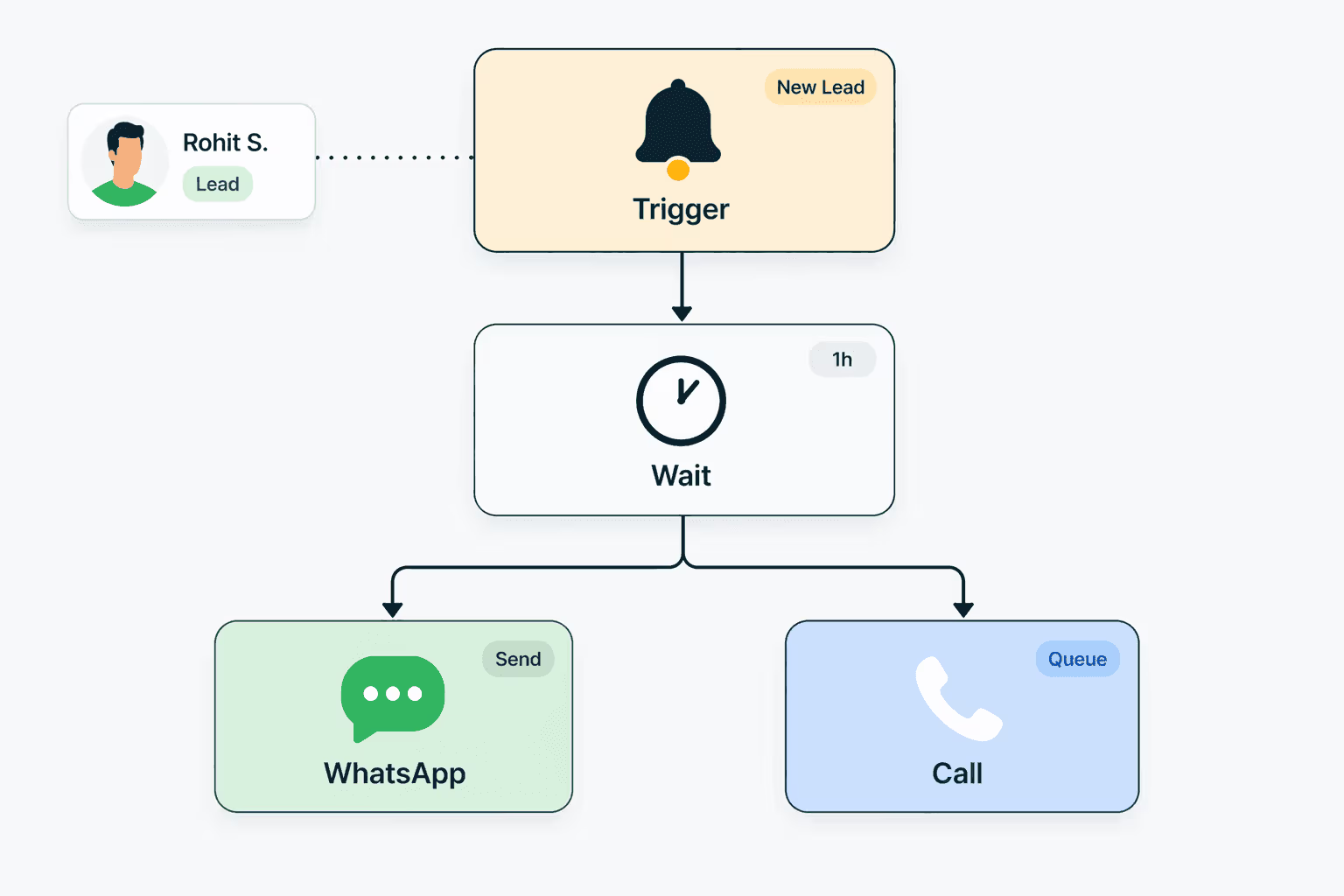
A marketing automation agency plans, builds, and manages the systems that handle your marketing and follow up automatically. That means capturing leads, responding to them instantly, nurturing the ones who are not ready yet, booking appointments, requesting reviews, and reporting on what worked. The goal is more booked work without hiring more people to chase it.
The important word is systems. A good agency does not just hand you software and a login. It designs the flow, connects the tools, writes the messages, and stays accountable for whether the phone turns into revenue.
The Four Jobs a Marketing Automation Agency Should Own
Strip away the jargon and the work breaks into four parts.
1. Strategy before software
Goals, KPIs, and the actual customer journey come first. Which leads are you losing, and where? A serious agency will map that before recommending a single platform. If the first conversation is a feature tour, you are talking to a reseller, not a partner.
2. Technical build and integration
This is the plumbing: connecting your phone system, your calendar, your CRM, your website forms, and your ad platforms so data flows in one direction instead of sitting in five disconnected silos.
3. Campaigns and content
Someone has to write the text messages, the emails, the call scripts, and the review requests. Automation without good copy is just faster spam.
4. Reporting and optimization
Not vanity metrics. Booked jobs, cost per booked job, and revenue recovered. If your monthly report does not tie back to money, it is decoration.
The Gap in Most Agencies: They Were Built for Software Companies
Here is the honest problem with the marketing automation industry. The playbook was written for B2B software: capture an email address, drop the lead into a nurture sequence, score their behavior over six months, and eventually hand a warm contact to a sales rep.
That playbook is useless when a homeowner’s water heater is spraying across the basement floor. And the data suggests even large marketing teams struggle with the exact thing service businesses live or die by, which is speed. In Salesforce’s tenth State of Marketing report, drawn from roughly 4,500 marketing leaders worldwide, most marketers admitted they struggle to respond to customers promptly, and a large majority conceded their campaigns are generic rather than personal. Slow and generic is the default state of marketing, even at companies with real budgets.
For a dental clinic or a home service business, slow and generic is fatal. Your customer is not on a six month journey. They are on a six minute journey, and it ends with whoever picks up the phone.
What Marketing Automation Actually Looks Like for a Service Business
Rebuild the system around how your customers actually behave, and it looks nothing like a nurture funnel.
The phone is the funnel
Most of your revenue arrives as a phone call, and phone leads convert far more often than form fills. So automation has to start at the ring, not at the email address. An AI voice receptionist answers every call, day or night, holds a natural conversation, and books the job straight into your calendar. That is not a nurture sequence. That is a front desk that never sleeps and never goes to lunch.
Missed call recovery
When a call does slip through, an instant missed-call text-back reaches the caller within seconds, before they dial the next name on Google. Roughly eight out of ten people who hit voicemail never leave a message, so silence is the same thing as losing the lead. If you want to see what that leak is worth in your business, run your numbers through the free missed call calculator.
Follow up and reactivation
Old quotes are the cheapest pipeline you own. A homeowner who got an estimate three months ago and went quiet is not a dead lead, they are an unfinished conversation. Automated lead follow-up works those lists on a schedule so nothing rots in a spreadsheet.
Reviews and reputation
For a local business, your Google rating is your storefront. Automated review requests go out to happy customers right after the job is done, when goodwill is at its peak, instead of whenever someone remembers to ask.
CRM as the single source of truth
Every call, text, quote, and booking lands in one place. CRM automation is what turns all of the above from a pile of tools into one system you can actually manage.
What Does a Marketing Automation Agency Cost?
Most agencies will not publish this, so here are the honest market ranges. Read them as a starting point and always confirm against a written scope of work.
Monthly retainers commonly land anywhere from about 1,000 dollars to 10,000 dollars or more, depending on scope. Some agencies charge a percentage of your ad spend, typically in the range of 10 to 20 percent. Others charge a flat monthly fee tied to a service tier, which is usually easier to budget around. Expect a one time setup or onboarding fee on top, and remember that agency fees sit on top of your software subscription, not inside it.
Two costs people forget. First, the platform itself: mid market marketing automation software can run from a few hundred to several thousand dollars a month on its own. Second, the alternative. Hiring a marketing operations person in house typically costs somewhere in the region of 80,000 to 130,000 dollars a year fully loaded, and that is before software. A retainer that bundles strategy, build, and management into one predictable line item is often the cheaper path for a business that is not ready for a full time hire.
The cheapest option is rarely the cheapest outcome. A badly built system usually costs more to untangle than it would have cost to build properly. If you want to see what transparent, service business pricing actually looks like, AI Globia publishes its pricing openly.
Your First 90 Days: What Good Looks Like
A real engagement has a shape. If your agency cannot describe one, that is a warning sign.
Weeks one and two are discovery and audit. They listen to your calls, look at your booking rate, find where leads are leaking, and agree on the numbers you will judge them by. Weeks two to four are the build: connecting the phone, calendar, and CRM, writing the scripts and messages, and testing everything before it touches a real customer. Most competent onboardings take two to four weeks, and clients who already have a CRM in place move faster.
From month two, you should be live and optimizing. Calls are being answered, missed callers are being texted, follow ups are running, and reviews are coming in. By day 90 you should not be looking at open rates. You should be looking at booked jobs and the cost per booked job, and you should be able to answer one question clearly: is more work landing on the calendar than before?
Seven Questions to Ask Before You Sign
Ask these on the first call. The answers separate a partner from a vendor.
What exactly will you be accountable for, and which number proves it? Are you platform agnostic, or do you resell one tool? Who writes the actual scripts and messages? What happens in the first 30 days, specifically? Do you have experience with my trade, and can you show it? Do I own the system, the data, and the phone number if I leave? And what is the total monthly cost including software, setup, and message fees?
Red Flags
Walk away if you hear guarantees. Nobody can promise you a fixed number of leads, and anyone who does is either guessing or lying. Be wary of long contracts with no exit, of reports full of impressions and open rates instead of booked jobs, and of any agency that cannot explain in plain English what a workflow does. Be especially cautious if they hand you a login and disappear. Setting up a platform is not the same thing as producing revenue.
Do You Even Need an Agency Yet?
Honest answer: maybe not. If you are answering nearly every call, your calendar is full, and you are not chasing quotes, automation will not fix a problem you do not have. Spend your money on demand instead.
But if you are missing calls during the workday, losing leads after hours, sitting on a graveyard of unfollowed quotes, or thinking about hiring a receptionist purely to answer the phone, then the system is the constraint, and that is exactly what a marketing automation agency is for.
Frequently Asked Questions
What does a marketing automation agency do?
It designs, builds, and runs the systems that capture leads, respond to them instantly, follow up automatically, book appointments, and request reviews, then reports on the revenue those systems produce.
Is it different from a digital marketing agency?
Yes. A digital marketing agency mostly generates demand through ads, SEO, and content. A marketing automation agency makes sure the demand you already have does not leak, by capturing, responding to, and converting it. Many businesses lose more money to leaks than to a lack of traffic.
How much does it cost?
Retainers commonly run from about 1,000 to 10,000 dollars a month depending on scope, sometimes charged as a flat fee and sometimes as 10 to 20 percent of ad spend. Software and setup fees are usually separate.
How long before I see results?
Setup typically takes two to four weeks. Missed call recovery tends to show results fastest because it works on demand you are already generating. Longer nurture and reactivation programs take a few months to compound.
Does marketing automation replace my staff?
No. It removes the repetitive work, answering the phone at 9 PM, chasing an old quote, asking for a review, so your team can do the parts that need a human being.
Where to Start
Most service businesses do not have a traffic problem. They have a response problem. The leads are already calling, and they are quietly leaking out through unanswered phones, unreturned voicemails, and quotes nobody followed up on. Automation is simply the decision to stop losing them.
If you want that system built for a dental clinic or a home service business rather than a software company, see how AI Globia works as a marketing automation agency for the trades, or book a free demo and hear your own AI receptionist answer a call.
For a closer look at how this plays out in one industry, read our breakdown of how AI receptionists help dental clinics recover missed calls. You can also browse the AI Globia blog for more practical guides, or see the full picture on the AI Globia homepage.
Leave a Reply